Definition Type: Element
Name: ConventionalUnit
Namespace: http://www.opengis.net/gml/3.2
Type: gml:ConventionalUnitType
Containing Schema: units.xsd
Abstract
Documentation:
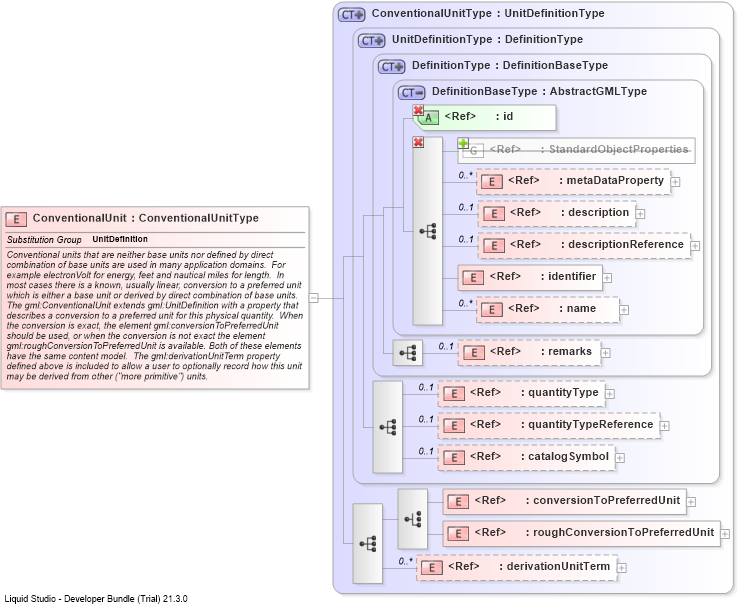
Conventional units that are neither base units nor defined by direct combination of base units are used in many application domains.  For example electronVolt for energy, feet and nautical miles for length.  In most cases there is a known, usually linear, conversion to a preferred unit which is either a base unit or derived by direct combination of base units.
The gml:ConventionalUnit extends gml:UnitDefinition with a property that describes a conversion to a preferred unit for this physical quantity.  When the conversion is exact, the element gml:conversionToPreferredUnit should be used, or when the conversion is not exact the element gml:roughConversionToPreferredUnit is available. Both of these elements have the same content model.  The gml:derivationUnitTerm property defined above is included to allow a user to optionally record how this unit may be derived from other ("more primitive") units.
Collapse XSD Schema Diagram:
Drilldown into derivationUnitTermDrilldown into roughConversionToPreferredUnitDrilldown into conversionToPreferredUnitDrilldown into catalogSymbolDrilldown into quantityTypeReferenceDrilldown into quantityTypeDrilldown into remarksDrilldown into nameDrilldown into identifierDrilldown into descriptionReferenceDrilldown into descriptionDrilldown into metaDataPropertyDrilldown into StandardObjectPropertiesDrilldown into idDrilldown into DefinitionBaseTypeDrilldown into DefinitionTypeDrilldown into UnitDefinitionTypeDrilldown into ConventionalUnitTypeXSD Diagram of ConventionalUnit
Collapse XSD Schema Code:
<element name="ConventionalUnit" type="gml:ConventionalUnitType" substitutionGroup="gml:UnitDefinition">
    <annotation>
        <documentation>Conventional units that are neither base units nor defined by direct combination of base units are used in many application domains.  For example electronVolt for energy, feet and nautical miles for length.  In most cases there is a known, usually linear, conversion to a preferred unit which is either a base unit or derived by direct combination of base units.
The gml:ConventionalUnit extends gml:UnitDefinition with a property that describes a conversion to a preferred unit for this physical quantity.  When the conversion is exact, the element gml:conversionToPreferredUnit should be used, or when the conversion is not exact the element gml:roughConversionToPreferredUnit is available. Both of these elements have the same content model.  The gml:derivationUnitTerm property defined above is included to allow a user to optionally record how this unit may be derived from other ("more primitive") units.</documentation>
    </annotation>
</element>
Collapse Child Elements:
Name Type Min Occurs Max Occurs
metaDataProperty gml:metaDataProperty 0 unbounded
description gml:description 0 (1)
descriptionReference gml:descriptionReference 0 (1)
identifier gml:identifier 0 (1)
name gml:name 0 unbounded
metaDataProperty gml:metaDataProperty 0 unbounded
description gml:description 0 (1)
descriptionReference gml:descriptionReference 0 (1)
identifier gml:identifier (1) (1)
name gml:name 0 unbounded
remarks gml:remarks 0 (1)
quantityType gml:quantityType 0 (1)
quantityTypeReference gml:quantityTypeReference 0 (1)
catalogSymbol gml:catalogSymbol 0 (1)
conversionToPreferredUnit gml:conversionToPreferredUnit (1) (1)
roughConversionToPreferredUnit gml:roughConversionToPreferredUnit (1) (1)
derivationUnitTerm gml:derivationUnitTerm 0 unbounded
<xs:group> gml:StandardObjectProperties (1) (1)
Collapse Child Attributes:
Name Type Default Value Use
id gml:id Required
Collapse Derivation Tree:
Collapse References:
gml:UnitDefinition