Definition Type: Element
Name: Observation
Namespace: http://www.opengis.net/gml/3.2
Type: gml:ObservationType
Containing Schema: observation.xsd
Abstract
Documentation:
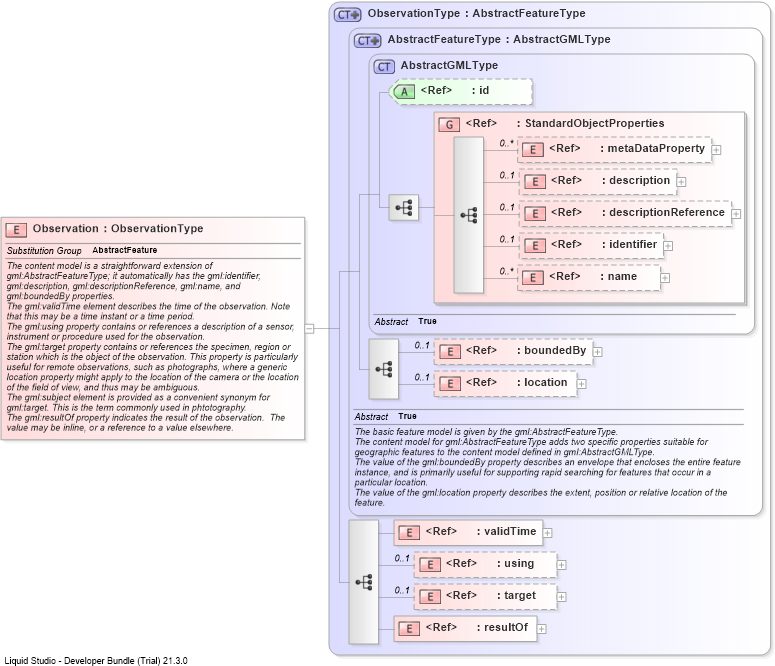
The content model is a straightforward extension of gml:AbstractFeatureType; it automatically has the gml:identifier, gml:description, gml:descriptionReference, gml:name, and gml:boundedBy properties. 
The gml:validTime element describes the time of the observation. Note that this may be a time instant or a time period.
The gml:using property contains or references a description of a sensor, instrument or procedure used for the observation.
The gml:target property contains or references the specimen, region or station which is the object of the observation. This property is particularly useful for remote observations, such as photographs, where a generic location property might apply to the location of the camera or the location of the field of view, and thus may be ambiguous.  
The gml:subject element is provided as a convenient synonym for gml:target. This is the term commonly used in phtotography.  
The gml:resultOf property indicates the result of the observation.  The value may be inline, or a reference to a value elsewhere.
Collapse XSD Schema Diagram:
Drilldown into resultOfDrilldown into targetDrilldown into usingDrilldown into validTimeDrilldown into locationDrilldown into boundedByDrilldown into nameDrilldown into identifierDrilldown into descriptionReferenceDrilldown into descriptionDrilldown into metaDataPropertyDrilldown into StandardObjectPropertiesDrilldown into idDrilldown into AbstractGMLTypeDrilldown into AbstractFeatureTypeDrilldown into ObservationTypeXSD Diagram of Observation
Collapse XSD Schema Code:
<element name="Observation" type="gml:ObservationType" substitutionGroup="gml:AbstractFeature">
    <annotation>
        <documentation>The content model is a straightforward extension of gml:AbstractFeatureType; it automatically has the gml:identifier, gml:description, gml:descriptionReference, gml:name, and gml:boundedBy properties. 
The gml:validTime element describes the time of the observation. Note that this may be a time instant or a time period.
The gml:using property contains or references a description of a sensor, instrument or procedure used for the observation.
The gml:target property contains or references the specimen, region or station which is the object of the observation. This property is particularly useful for remote observations, such as photographs, where a generic location property might apply to the location of the camera or the location of the field of view, and thus may be ambiguous.  
The gml:subject element is provided as a convenient synonym for gml:target. This is the term commonly used in phtotography.  
The gml:resultOf property indicates the result of the observation.  The value may be inline, or a reference to a value elsewhere.
</documentation>
    </annotation>
</element>
Collapse Child Elements:
Name Type Min Occurs Max Occurs
metaDataProperty gml:metaDataProperty 0 unbounded
description gml:description 0 (1)
descriptionReference gml:descriptionReference 0 (1)
identifier gml:identifier 0 (1)
name gml:name 0 unbounded
boundedBy gml:boundedBy 0 (1)
location gml:location 0 (1)
validTime gml:validTime (1) (1)
using gml:using 0 (1)
target gml:target 0 (1)
resultOf gml:resultOf (1) (1)
<xs:group> gml:StandardObjectProperties (1) (1)
Collapse Child Attributes:
Name Type Default Value Use
id gml:id (Optional)
Collapse Derivation Tree:
Collapse References:
gml:AbstractFeature