Definition Type: Element
Name: TimeCalendarEra
Namespace: http://www.opengis.net/gml/3.2
Type: gml:TimeCalendarEraType
Containing Schema: temporalReferenceSystems.xsd
Abstract
Documentation:
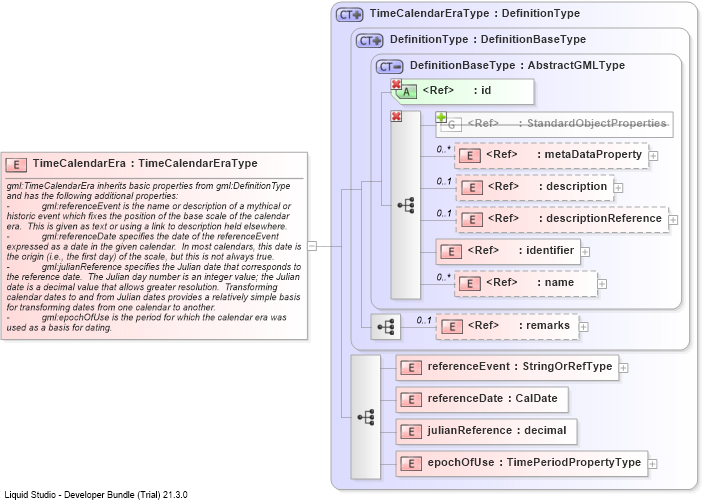
gml:TimeCalendarEra inherits basic properties from gml:DefinitionType and has the following additional properties:
-	gml:referenceEvent is the name or description of a mythical or historic event which fixes the position of the base scale of the calendar era.  This is given as text or using a link to description held elsewhere.
-	gml:referenceDate specifies the date of the referenceEvent expressed as a date in the given calendar.  In most calendars, this date is the origin (i.e., the first day) of the scale, but this is not always true.
-	gml:julianReference specifies the Julian date that corresponds to the reference date.  The Julian day number is an integer value; the Julian date is a decimal value that allows greater resolution.  Transforming calendar dates to and from Julian dates provides a relatively simple basis for transforming dates from one calendar to another.
-	gml:epochOfUse is the period for which the calendar era was used as a basis for dating.
Collapse XSD Schema Diagram:
Drilldown into epochOfUseDrilldown into julianReferenceDrilldown into referenceDateDrilldown into referenceEventDrilldown into remarksDrilldown into nameDrilldown into identifierDrilldown into descriptionReferenceDrilldown into descriptionDrilldown into metaDataPropertyDrilldown into StandardObjectPropertiesDrilldown into idDrilldown into DefinitionBaseTypeDrilldown into DefinitionTypeDrilldown into TimeCalendarEraTypeXSD Diagram of TimeCalendarEra
Collapse XSD Schema Code:
<element name="TimeCalendarEra" type="gml:TimeCalendarEraType">
    <annotation>
        <documentation>gml:TimeCalendarEra inherits basic properties from gml:DefinitionType and has the following additional properties:
-	gml:referenceEvent is the name or description of a mythical or historic event which fixes the position of the base scale of the calendar era.  This is given as text or using a link to description held elsewhere.
-	gml:referenceDate specifies the date of the referenceEvent expressed as a date in the given calendar.  In most calendars, this date is the origin (i.e., the first day) of the scale, but this is not always true.
-	gml:julianReference specifies the Julian date that corresponds to the reference date.  The Julian day number is an integer value; the Julian date is a decimal value that allows greater resolution.  Transforming calendar dates to and from Julian dates provides a relatively simple basis for transforming dates from one calendar to another.
-	gml:epochOfUse is the period for which the calendar era was used as a basis for dating.</documentation>
    </annotation>
</element>
Collapse Child Elements:
Name Type Min Occurs Max Occurs
metaDataProperty gml:metaDataProperty 0 unbounded
description gml:description 0 (1)
descriptionReference gml:descriptionReference 0 (1)
identifier gml:identifier 0 (1)
name gml:name 0 unbounded
metaDataProperty gml:metaDataProperty 0 unbounded
description gml:description 0 (1)
descriptionReference gml:descriptionReference 0 (1)
identifier gml:identifier (1) (1)
name gml:name 0 unbounded
remarks gml:remarks 0 (1)
referenceEvent gml:referenceEvent (1) (1)
referenceDate gml:referenceDate (1) (1)
julianReference gml:julianReference (1) (1)
epochOfUse gml:epochOfUse (1) (1)
<xs:group> gml:StandardObjectProperties (1) (1)
Collapse Child Attributes:
Name Type Default Value Use
id gml:id Required
Collapse Derivation Tree: