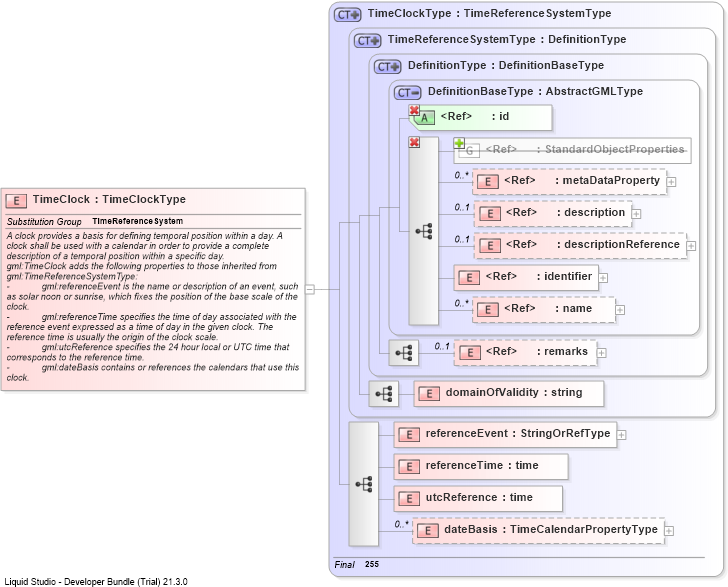
Definition Type: Element
Name: TimeClock
Namespace: http://www.opengis.net/gml/3.2
Type: gml:TimeClockType
Containing Schema: temporalReferenceSystems.xsd
Abstract
Documentation:
A clock provides a basis for defining temporal position within a day. A clock shall be used with a calendar in order to provide a complete description of a temporal position within a specific day.
gml:TimeClock adds the following properties to those inherited from gml:TimeReferenceSystemType:
-	gml:referenceEvent is the name or description of an event, such as solar noon or sunrise, which fixes the position of the base scale of the clock.
-	gml:referenceTime specifies the time of day associated with the reference event expressed as a time of day in the given clock. The reference time is usually the origin of the clock scale. 
-	gml:utcReference specifies the 24 hour local or UTC time that corresponds to the reference time.
-	gml:dateBasis contains or references the calendars that use this clock.
Collapse XSD Schema Diagram:
Drilldown into dateBasisDrilldown into utcReferenceDrilldown into referenceTimeDrilldown into referenceEventDrilldown into domainOfValidityDrilldown into remarksDrilldown into nameDrilldown into identifierDrilldown into descriptionReferenceDrilldown into descriptionDrilldown into metaDataPropertyDrilldown into StandardObjectPropertiesDrilldown into idDrilldown into DefinitionBaseTypeDrilldown into DefinitionTypeDrilldown into TimeReferenceSystemTypeDrilldown into TimeClockTypeXSD Diagram of TimeClock
Collapse XSD Schema Code:
<element name="TimeClock" type="gml:TimeClockType" substitutionGroup="gml:TimeReferenceSystem">
    <annotation>
        <documentation>A clock provides a basis for defining temporal position within a day. A clock shall be used with a calendar in order to provide a complete description of a temporal position within a specific day.
gml:TimeClock adds the following properties to those inherited from gml:TimeReferenceSystemType:
-	gml:referenceEvent is the name or description of an event, such as solar noon or sunrise, which fixes the position of the base scale of the clock.
-	gml:referenceTime specifies the time of day associated with the reference event expressed as a time of day in the given clock. The reference time is usually the origin of the clock scale. 
-	gml:utcReference specifies the 24 hour local or UTC time that corresponds to the reference time.
-	gml:dateBasis contains or references the calendars that use this clock.</documentation>
    </annotation>
</element>
Collapse Child Elements:
Name Type Min Occurs Max Occurs
metaDataProperty gml:metaDataProperty 0 unbounded
description gml:description 0 (1)
descriptionReference gml:descriptionReference 0 (1)
identifier gml:identifier 0 (1)
name gml:name 0 unbounded
metaDataProperty gml:metaDataProperty 0 unbounded
description gml:description 0 (1)
descriptionReference gml:descriptionReference 0 (1)
identifier gml:identifier (1) (1)
name gml:name 0 unbounded
remarks gml:remarks 0 (1)
domainOfValidity gml:domainOfValidity (1) (1)
referenceEvent gml:referenceEvent (1) (1)
referenceTime gml:referenceTime (1) (1)
utcReference gml:utcReference (1) (1)
dateBasis gml:dateBasis 0 unbounded
<xs:group> gml:StandardObjectProperties (1) (1)
Collapse Child Attributes:
Name Type Default Value Use
id gml:id Required
Collapse Derivation Tree:
Collapse References:
gml:TimeReferenceSystem