Definition Type: Element
Name: TimePeriod
Namespace: http://www.opengis.net/gml/3.2
Type: gml:TimePeriodType
Containing Schema: temporal.xsd
Abstract
Documentation:
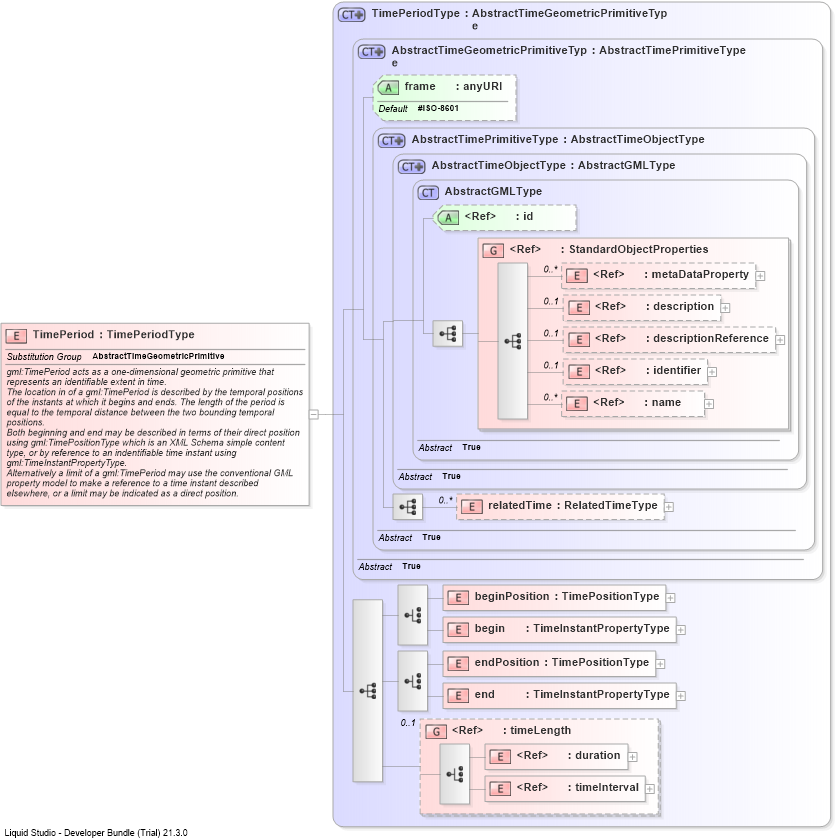
gml:TimePeriod acts as a one-dimensional geometric primitive that represents an identifiable extent in time.
The location in of a gml:TimePeriod is described by the temporal positions of the instants at which it begins and ends. The length of the period is equal to the temporal distance between the two bounding temporal positions. 
Both beginning and end may be described in terms of their direct position using gml:TimePositionType which is an XML Schema simple content type, or by reference to an indentifiable time instant using gml:TimeInstantPropertyType.
Alternatively a limit of a gml:TimePeriod may use the conventional GML property model to make a reference to a time instant described elsewhere, or a limit may be indicated as a direct position.
Collapse XSD Schema Diagram:
Drilldown into timeIntervalDrilldown into durationDrilldown into timeLengthDrilldown into endDrilldown into endPositionDrilldown into beginDrilldown into beginPositionDrilldown into relatedTimeDrilldown into nameDrilldown into identifierDrilldown into descriptionReferenceDrilldown into descriptionDrilldown into metaDataPropertyDrilldown into StandardObjectPropertiesDrilldown into idDrilldown into AbstractGMLTypeDrilldown into AbstractTimeObjectTypeDrilldown into AbstractTimePrimitiveTypeDrilldown into frameDrilldown into AbstractTimeGeometricPrimitiveTypeDrilldown into TimePeriodTypeXSD Diagram of TimePeriod
Collapse XSD Schema Code:
<element name="TimePeriod" type="gml:TimePeriodType" substitutionGroup="gml:AbstractTimeGeometricPrimitive">
    <annotation>
        <documentation>gml:TimePeriod acts as a one-dimensional geometric primitive that represents an identifiable extent in time.
The location in of a gml:TimePeriod is described by the temporal positions of the instants at which it begins and ends. The length of the period is equal to the temporal distance between the two bounding temporal positions. 
Both beginning and end may be described in terms of their direct position using gml:TimePositionType which is an XML Schema simple content type, or by reference to an indentifiable time instant using gml:TimeInstantPropertyType.
Alternatively a limit of a gml:TimePeriod may use the conventional GML property model to make a reference to a time instant described elsewhere, or a limit may be indicated as a direct position.</documentation>
    </annotation>
</element>
Collapse Child Elements:
Name Type Min Occurs Max Occurs
metaDataProperty gml:metaDataProperty 0 unbounded
description gml:description 0 (1)
descriptionReference gml:descriptionReference 0 (1)
identifier gml:identifier 0 (1)
name gml:name 0 unbounded
relatedTime gml:relatedTime 0 unbounded
beginPosition gml:beginPosition (1) (1)
begin gml:begin (1) (1)
endPosition gml:endPosition (1) (1)
end gml:end (1) (1)
duration gml:duration (1) (1)
timeInterval gml:timeInterval (1) (1)
<xs:group> gml:StandardObjectProperties (1) (1)
<xs:group> gml:timeLength 0 (1)
Collapse Child Attributes:
Name Type Default Value Use
id gml:id (Optional)
frame gml:frame #ISO-8601 (Optional)
Collapse Derivation Tree:
Collapse References:
gml:AbstractTimeGeometricPrimitive